Monday, August 19, 2013

Keeping It Surreal in "The House Dali Built"

Perhaps His Most Famous Image -- Warped Time-- Dali was Intensely
 Interested in Einstein's Theory of Time, the Atomic Age, and Anything
Dealing with Dreams or Sigmund Freud
(All Photos Taken by Drew Smith)
The first rule of "The House Dali Built" is "Break All the Rules." There is a warning outside the museum of the famous Surrealist, Salvador Dali: "Do Not Attempt to Tour the Museum With a Prefigured Plan, Dali Would Not Approve!" By the time you scroll to the bottom of this blog post, about the time you see the life-size "Apartment of Mae West", you will understand. This is also his final resting place.

Welcome to the "Theater Museum of Salvador Dali," the most visited place in the Catalonia Region of Spain, despite the fact it is located in a relatively obscure place --the small village of Figueres -- halfway up the Mediterranean coast between Barcelona, the capital of Catalonia, and the French border.

The Other Side of the Dali Museum & Theater at Night (He Had a Thing for Eggs)
So, why this strange warning on the brochure and signs for our visit to the "Teatre Museu Dali"? Mr. Dali personally could not condone something so confining as a pre-planned route, or map, with a disciplined and orderly approach to viewing his art.

Pink Blob: Notice the Hand Coming Out of the Top
You see, why on earth would someone who fought order, structure and boundaries with his life's work want to make the experience of viewing that work the very opposite experience... especially when so often this artist tries to make you an active part of his canvas?

Salvadore and Gala's Bed (Notice the Skeleton)
If you have ever gotten turned around in an art gallery, as I have, and had to stare at the color-coded crazy brochure to figure out where you are, then you will find this place a welcome relief.

Indeed, Salvador Dali -- another "lost generation" member like Hemingway -- uses the entire theater-museum as his canvas. It is easily the most remarkable and unforgettable art exhibit I have ever witnessed, and may ever again...  Hence the overwhelming popularity.


Dali was born here in Figueres, christened in the ancient church just steps away, and attended the theater and later movies in this building as a young boy. It was also in the lobby of the original theater that he first exhibited his early works of art to the public.

During the Spanish Civil War, in the 1930s, the forces of Franco bombed the theater until it was but a shell. In later years, when an effort began to save the theater from demolishing, Dali offered to make this theater the museum of his life's work... and what a remarkable life and work it was.

This is a Good View of the Middle of the Museum,
Which Had Been Bombed Out in the Spanish Civil War
Dali said that one reason he picked this as the spot to exhibit his life's work is because he thought it was appropriate to use a theater, since his work and he were very "theatrical" in nature. Indeed, Dali was a master at using modern communication to build his image, and was somewhat jealous of the fame received by his friend and sometimes-rival just down the road, Pablo Picasso.

The Painting of Lincoln in the Background?
Up Close It is a Painting of a Nude Woman... Really
We had left Barcelona by rental car, early that morning, with me behind the wheel. This gave Drew lots of fun at my expense, comparing me to Chevy Chase in the Grizwald "European Vacation" movies.

Dad and Me Walking the Streets of Figueres
Looking at Dad's tourist guide, I noticed that Dali's town and museum were not far from our planned route to France. We had to stop.

After parking in a typical Spanish parking garage (no SUVs need even try, I might add, they are so small), we walked across the street to this remarkable building and town center.

A Long Line Awaited Us at the Most
Popular Tourist
Attraction in Catalonia
We immediately saw the line that was at least 50 yards long. This was evidence to me that we MUST SEE this museum. It was the longest line of any I would see in Barcelona or throughout my tour of Spain.

Plenty of People Were On Hand
to Entertain Us as We Waited In Line
While we were waiting, we took turns visiting the town church, where you could see the famous panorama of the "Holy Land" and see the baptismal font where the baby Dali was christened. I am not sure, but I do not think he had his trademark mustache at that point.

Eventually, we made it inside. What can I say.... it lived up to the hype. We were not disappointed. Dali lived most of his days not too far away, in a small fishing village on the Mediterranean. I would have loved to visit his home, his art studios, and the rest that are all still exactly like there were when he died.


We all agreed that the detour was a good idea, and well worth the time. The Dali Museum was a visual feast. If you are ever in the vicinity, it is worth a day trip to see, or I should say experience this place.

Dad In Front of Dali's Car -- Which Has A Manikin Inside at the Wheel,
a Living Garden and a Watering System 


By the way, these photographs are another example of Dali's "no rules" legacy for his museum. Every other art gallery I have been in I could not take photographs. In Dali's house such a thing is unthinkable... why you are as much a part of the show as he, don't you see. Not allowed to take pictures? Ridiculous! Drew could take pictures until his heart's content, with no pesky guard scorning him.

Dali also had a life-long love affair with his wife Gala, and she was the subject of many of his paintings throughout the gallery.

Portrait of the Love and the Muse of His Life -- Dali's Wife Gala
(Learn More at http://www.salvador-dali.org/dali/en_biografia-gala.html)

Dali's Famous Appartment "Me West" -- This is Furniture in a
Room About 750 square feet

You Walk Up a Ladder and look through a Viewer and... It is Mae West
Yep, Mae West! (For Fun, Zoom This Picture as Large as You Can
 to see the People in Line on the Right and Coming in the "apartment" on the Left)

The Cryp 

Perhaps the most real part of this museum is the crypt where Dali is buried, underneath where the original stage for the theater once existed. In the end, surrounded by his masterpieces, it seems fitting that this theatrical showman, this rule breaker, this amazing artist, should be buried in this place for eternity.

If you have read this far, I strongly recommend you view the entire collection with explanations of his art found at this website:http://www.salvador-dali.org/dali/coleccio/en_50obres.html

One of the most interesting pieces on Dali, by the way, is an old black and white masterpiece, discussed here:http://www.closeupfilmcentre.com/vertigo_magazine/issue-14-december-2007/arden-and-dali-loiter-in-the-streets/

My next post is from France: "La Tour de Jour: My Day at the 100th Anniversary of the Tour de France." Until then.... stay surreal!

Sunday, August 11, 2013

Barcelona = Mediterranean, Gaudi, Picasso, Dali, Beaches, Catalonians = Beauty

Entrance to Guell Park -- Both de Gaudi Buildings (All Photos Credited to Drew Smith)
To be in Barcelona is to be in a painting...to be inside a moving work of art. The beauty is so ubiquitous that you find that even you are a part of it. You are watching it and a part of it at the same time. The visual feast begins with the mountain backdrops next to the blues of the Mediterranean Sea, continuing with the architecture of de Gaudi, the paintings of Picasso, and -- of course -- the beauty of the catalonian people, all enframed by the swaying green palm trees, enraptured by a soft sea breeze everywhere you go. It is easy to see why this is a major Honeymoon destination.

The Palm Tree Laden Parc Guell -- Another Gaudi Masterpiece (View from the Top)
Drew and I hiked to the very top point overlooking the city, in preparation for Kili and for the great view, while Dad enjoyed sitting at the outdoor cafe below. After leaving this park, you should stop by “The Gaudi 4 D Experience” which pays tribute to his life and work in an amazingly high tech way.
Everywhere you look there is art... inside buildings with the famous Pablo Picasso Art Gallery, in the many parks, in the street art, and best of all -- the buildings themselves.


Barcelona Beach Front -- Ten Miles on the Med
Located on the Mediterranean, with nearly ten miles of beachfront, Barcelona is considered the capital of the Catalonian Region of Spain. It has a very pleasant climate, with a constant ocean breeze, the mediterranean dry heat, and palm trees everywhere.


My son, Drew, wanted us to see a city he has visited four times now. I am glad he did. It is truly striking and is the kind of place that can only be taken in by being there in person.


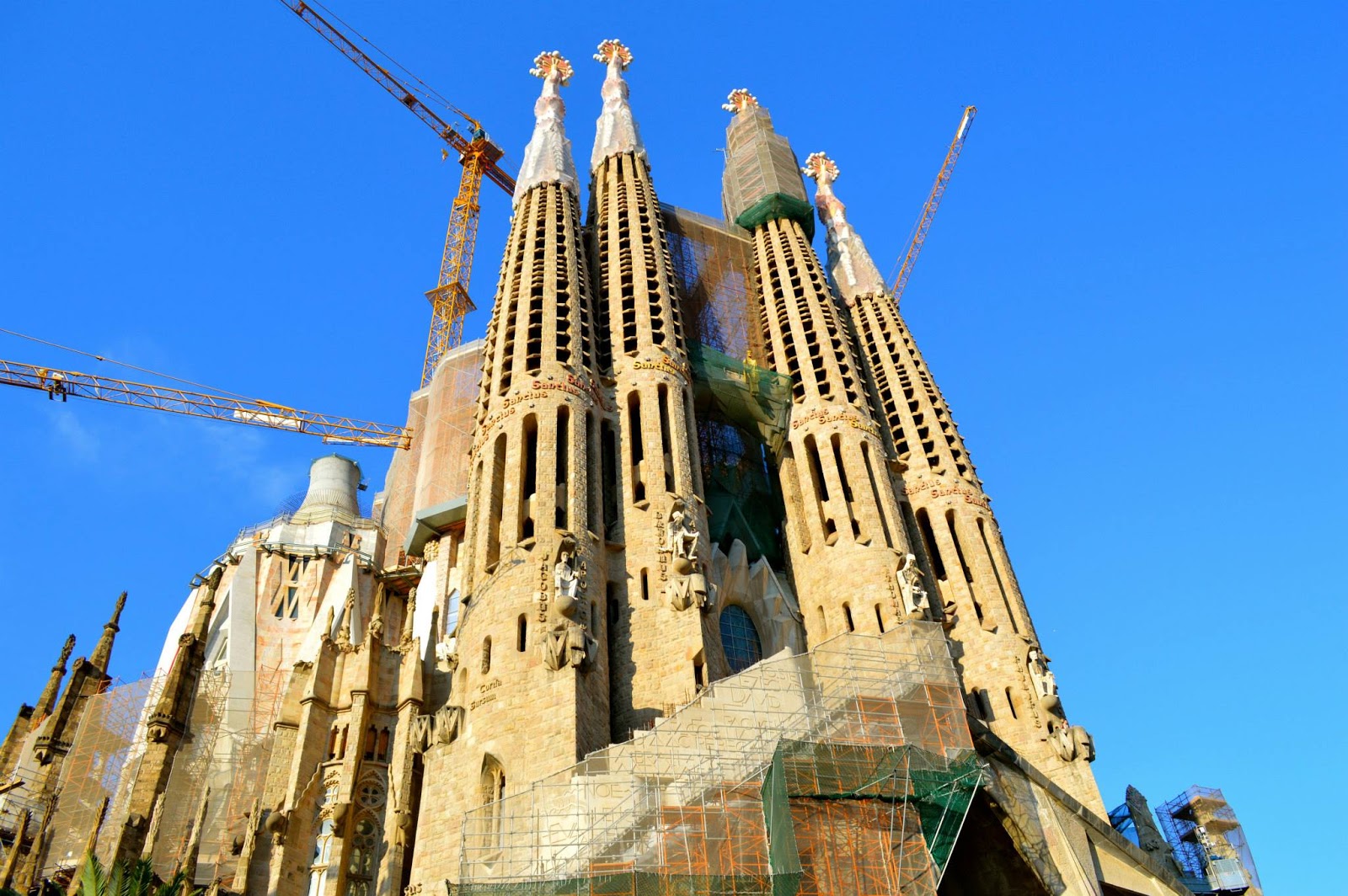
de Gaudi's "Temple of the La Sagrada Familia" Still Under Construction is a Must See
First, of course, you must see the Temple of the La Sagrada Familia" designed by Antonia Gaudi -- the modernist architectural genius who is the best known architect of the region and perhaps the best known modernist period. He considered this his finest masterpiece, but he also designed the city's main park overlooking the entire city, as well as several key buildings and villas during the time he was alive.
Dad Sitting Next to a Life Size Statue of de Gaudi in the "Gaudi 4D Experience Museum" Near the Parc Guell


We were also able to go swimming in the Mediterranean -- one of the bluest places you will ever visit. Drew and I wanted to check that one off our list of oceans and seas to swim in, plus it was the closest thing to a “beach day” that I am likely to see this year. Dad also took a dip. The place is clothing optional, but nobody seemed to care or even notice. It was not a big deal... but I have a feeling the Americans in the area were pretty shocked.


Barcelona has many outdoor cafes and bars, and entire avenues and plazas where people like to stroll outside in the pleasant climate. We highly recommend ordering the calamari. I am not sure what it is but we found it to be the most amazing calamari in the world! A must!


Another must is the Bar Marsella, which I blogged about in an earlier post ("Midnight in Barcelona"). It has been untouched for over 100 years, has been there for 150 years, was where Hemingway, Gaudi, Picasso, Dali and many others drank a new drink invented there known as absinthe. It was hard to find, and now is in jeopardy of closing due to a developer. Sign the petition on-line to keep it open. In my opinion, the Bar Marsella puts the "bar" in "Barcelona".


Sign the petition on-line to keep it open. In my opinion, the Bar Marsella puts the "bar" in "Barcelona".


Of course, Dad and I had a mission to make the Picasso Art Museum, one of his favorites and also a member of “The Lost Generation” with Hemingway. It is located in a beautiful old villa in the middle of “the old town” section of Barcelona, where the streets are so narrow there is limited access by automobiles. The museum was created by one of his friends during his lifetime and contains the largest Picasso collection anywhere. The visit here was one of the most “Old Europe” places of our trip, and if you go there it is a must.


Inside the Picasso Museum


Dad also has always loved the “Flamenco Dancers” of Spain. Although Drew tells us that the real culture of “Flamenco” is in Southern Spain, we got away for a performance and dinner the night before our departure for France... figuring we might not get that opportunity again.


We also rented a car... something I highly recommend you research before you attempt. We managed it somehow, and after spending three days in this beautiful city were sad to leave for France the next day. But before we left, we would stop at one of the most unique museums in Spain and in the World -- the Salvador Dali Theatre-Museum just south of the French border, in the Artist's hometown of Figueres. It is the most visited site in Catalonia. When you see my next blog post, you will see why.

Old Barcelona -- Cars are not allowed. Very Narrow Streets. This is Where the Picasso Museum is located


The Famous Gaudi Dragon -- Good Luck to Put Your Hand in His Mouth


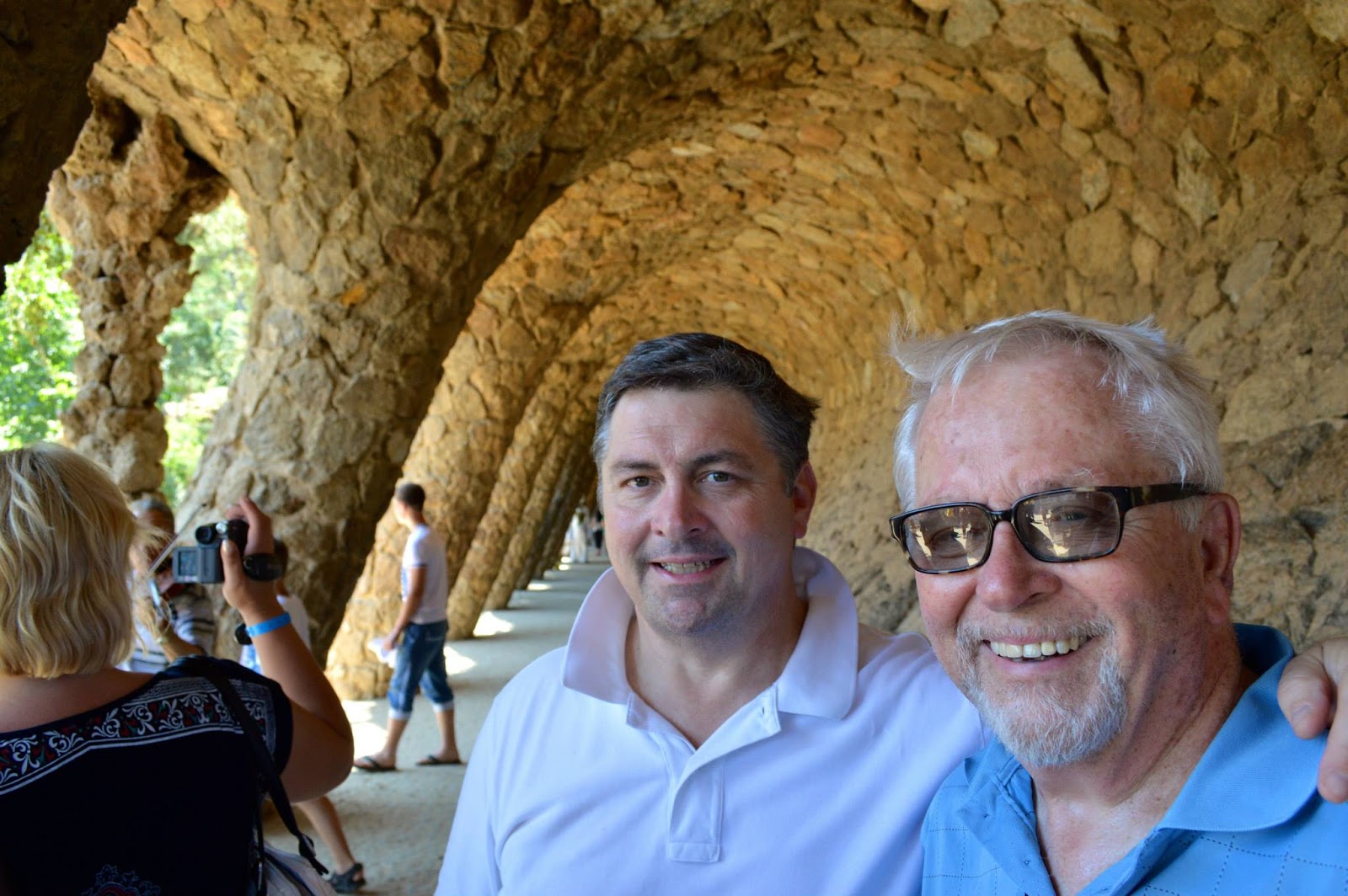
In the Gaudi "Caves" at the Park
Looking Relaxed on top of the Double Decker Tour Bus


Drew On Top of the Highest Place at the Parc
In the Plaza where Drew and Nate Stayed at the Hostel, and Where the Calamari is Amazing!


Wednesday, July 3, 2013

Midnight in Barcelona

Absinthe at the Bar Marsella -- Where It Began (photo credit Drew Smith)
If you read this blog, my bet is you have seen the Woody Allen Movie "Midnight in Paris" about the nostalgic young American writer who goes back in time to "The Dingo" in 1920s Paris every night at the stroke of 12, spending time with the "Lost Generation" of Hemingway, the Fitzgeralds, Picasso, Stein, Dali and more.

In Barcelona, on a little forgotten street a few blocks from "the tourist section" is a little bar named "The Bar Marella" where you can experience your own nostalgic time travel. This bar is 200 years old and has not been dusted or changed whatsoever since the 1920s. It is the place given credit for introducing Absinthe -- the drink of choice for many of the Lost Generation as well as others. It was outlawed once upon a time but came back after the wormwood used in the original form was removed from the process.
Notice the Dust (photo Drew Smith)
Drew, Dad and I went looking for the Bar Marsella -- where the likes of Hemingway, Picasso, Dali, and the famous architect Antoni Gaudi, the genius behind all of the wonders of Barcelona, spent time here drinking the famous drink. While Madrid was Hemingway's favorite Spanish city, when he visited Barcelona this was his favorite bar. It was also the actual location used in another Woody Allen movie, "Vicky Christina Barcelona" (2008).


After Drew left to meet a college friend from Spain, Dad and I met a wonderful couple and we asked them to join us. Laura and Eric were there for the same reasons... literary nerdism. We had run into each other earlier that evening. Once we found the bar, an adventure in and of itself, it looked like it might be closed down. Not to worry, the prostitutes of the area, as well as the policeman, informed us it would not open until 11pm. It turns out this is considered something of a "Red Light District" for Barcelona... and apparently prostitution is legal here since the policeman was working the same block. However, as we all agreed, since the prostitutes were there in the 1920s as well, back when this was known as the place to be, it actually led to the ambiance in strange way. There were no hordes of tourists, something we had been fighting (and contributing to) all day.
With Eric of Portugal and Laura of Atlanta, with Dad at the Bar Marsella
Nope. As the clock struck midnight, and Laura and Eric and Dad and I sat there trading rounds of absinthe (Dad only had one), it dawned on me that this new day was the anniversary of Ernest Hemingway's death. I took the occasion to offer a toast to the man, in his bar, with his drink, among new friends who shared a love of his work just as I do. Whether or not Hemingway's ghost was present, his spirit no doubt was there that night.

You can cut the nostalgia with a knife, almost literally. The paint is peeling. The bottles and pictures on the walls are from the 1920s. The bar keepers did not dress in period costume, but that would have just made it a tourist thing anyway.

Yep, this was a surreal experience -- my very own "Midnight in Paris" and my own Dingo Bar. It is all the more fitting since the greatest surrealist himself -- Salvadore Dali -- used to drink here as well

. 

We shared more rounds of absinthe than I care to (or frankly am able to) remember. Just as I had read in a New York Times article, the real crowd did not show up until after mid-night as well. Eventually, the place was full of people from every walk of life. There was one college-age French Art Student in the corner who was lighting her sugar cube with a bic before the ritualistic pouring of water over the sugar cube to give it a caramelized taste -- a welcome thing if you do not like the taste of licorice. She also knew the reputation of the bar, and sat in the corner drawing the scene that night. The locals hung out at the bar and laughing with friends.

In short, it was perhaps the most memorable way I could kick off "the Hemingway portion" of my trip. Sadly, the Bar Marsella is under siege. The owners of the building in which it is located want to sell. There is a fear that the property will be redeveloped. The city sees it as a way to clean up an area that is very close to the main "tourist" area, if unseen and unknown by most of them right now.

There is a petition online to ask the city to buy it for the $1 million asking price and save it just like it is... no changes, no neon signs, just nostalgia, history, and the authentic and very real experience of traveling back in time. Please Google "Save the Bar Marsella" and sign the petition. Better yet, buy it and move there. You will not regret it.

Save the Bar Marsella!